

Generations
What we inherit and what we bequeath.
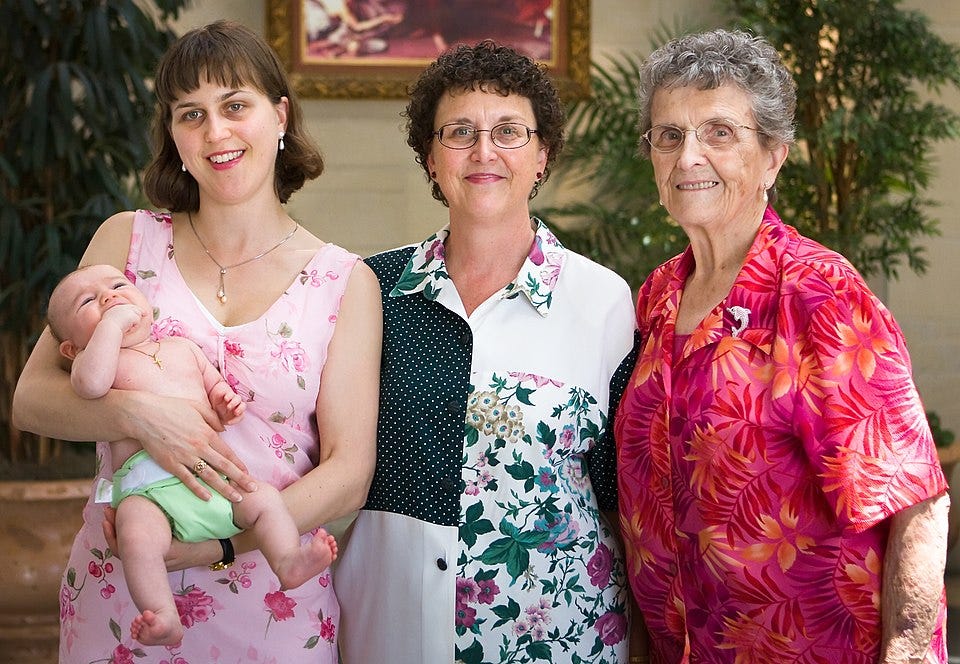
My Mom was born in Manhattan to a Jewish family. She wore her mind on her sleeve. Everything she thought tended to come straight out of her mouth. We could easily engage in conversation. My Dad, born into a Nebraska farm family, spoke little and was, on occasion, disinterested in what I had to say. My communication with elementary school classmates resembled that of my Mom’s unfiltered offerings, and that resulted in many awkward conversations. Later in life, I have tended to be more reticent, like my Dad.
I can see that who I turned out to be is, in some measure, influenced by my parents, and I remain curious about all the events and forces that have affected the way I am today.
Our life journeys and the journeys of our ancestors and offspring weave a tapestry of experience into which we are woven. Each generation modifies the threads of the tapestry through their experience, so each generation’s inheritance is different than that received by the previous generation.
Store Consciousness
Thich Nhat Hanh talks about store consciousness, where the seeds of everything can be found. In our interactions with others, we receive seeds from others and give seeds to others. We may give or receive the seed of an emotion or idea. If we are aware of it, we can choose to water it so it will manifest within us and/or in the universe at large, or we can ignore it so that it does not.
… if you water a seed of peace in your mind, peace will grow. When the seeds of happiness in you are watered, you will become happy. When the seed of anger in you is watered, you will become angry. The seeds that are watered frequently are those that will grow strong.
Although we are born with a genetic inheritance of traits, we have some agency in how we decide to be in the world. We can choose to love, and be happy, or hate, and be angry. Anger is suffering. Aware of the seed of anger, we can choose not to water that seed so that it will not grow. Watering the seeds of compassion within us, we blossom like a flower.
Genetic Inheritance
Significant characteristics of our physical selves are molded by the genes of our ancestors - the color of our eyes, our height, whether we are female or male, and to an extent, what we think and do.
Verywell Mind provides a list of personality traits that may possibly be inherited. I paraphrase:
Evidence suggests that these Big Five personality traits tend to be inherited to a certain degree. The five traits that make up personality and are influenced by genetics are openness, conscientiousness, extroversion, agreeableness, and neuroticism …
Openness: creative, open to trying new things, happy to think about abstract concepts
Conscientiousness: high levels of thoughtfulness, good impulse control, and goal-directed behaviors
Extraversion: sociability, talkativeness, assertiveness, and excitability
Agreeableness: trust, altruism, kindness, affection, and other prosocial behaviors
Neuroticism: sadness, moodiness, emotional instability, worries about many different things
Our parents pass down to us elements of their own genetic makeup. According to EBSCO:
… traits are passed from parents to offspring, primarily through … genes. Inheritance patterns can be complex, with traits often influenced by multiple genes and environmental factors. Some traits follow straightforward dominant or recessive inheritance patterns, while others, such as sex-linked traits, are inherited through chromosomes that differ between males and females.
Science tells us that the terms, ‘male’ and ‘female,’ are like the terms, ‘black’ and ‘white.’ As between black and white exist many shades of color, between male and female there are many variations. Sometimes these variations are the result of having inherited a chromosome arrangement differing from the decisive XY or XX combinations, but in other instances as a result of other factors.
The Hudson Institute of Medical Research provides this list of gender-related terms and a short explanation:
Sex refers to the physical appearance you were born with.
Gender identity refers to a fundamental sense of belonging and self-identification of being female, male, both, or something other than female or male. It does not necessarily correspond to the sex assigned or presumed at birth.
Sexual orientation is the sex of the person to whom one is sexually attracted. It may include heterosexual, bisexual, homosexual, pan-sexual, or asexual.
Intersex is an umbrella term for people whose reproductive organs, sexual anatomy or chromosome patterns differ from the biological definition of male or female. We call these conditions Differences of Sex Development, or DSDs.
There are many ways someone can be intersex as it involves a spectrum of reproductive characteristics. Being intersex is not the same as being Trans, which is when a person does not identify with their biological sex. Typically transgender people look male or female at birth, very rarely have a DSD condition, and identify as the sex opposite to their appearance at birth.
Gender has a profound effect on who we think we are, in large part due to powerful societal pressures, as illustrated in part by the current controversy over transgender athletes.
Genetics have a significant role in who we are and who we become, and we have little control over the genes that we inherit. We can, sometimes, influence how our genes are expressed, and how our genetic inheritance manifests is also influenced by our environment.
Nature vs. Nurture
“Nature and nurture is a convenient jingle of words, for it separates under two distinct heads the innumerable elements of which personality is composed. Nature is all that a man brings with himself into the world; nurture is every influence from without that affects him after his birth.” – Francis Galton, cousin of Charles Darwin, 1874.
Inherited traits may manifest in many ways and to many degrees, and are, to varying degrees, influenced by environment and by choice.
Paraphrasing Harvard Medical School:
A study reveals just how interwoven nature and nurture are.
… the team looked at how a single sensory experience affects gene expression in the brain. Their findings revealed a dramatic and diverse landscape of gene expression changes across all cell types, involving 611 different genes, many linked to neural connectivity and the brain’s ability to rewire itself to learn and adapt…
Our life experiences can affect how our genes are expressed, that is, how they manifest changes in our bodies and minds. Paraphrasing the National Institutes of Medicine,
Gene expression is the process by which the information encoded in a gene is turned into a function. … Gene expression [can] be thought of as an “on/off switch” to control when and where RNA molecules and proteins are made and as a “volume control” to determine how much of those products are made.
Paraphrasing Frontline Genomics :
Epigenetics is the study [of genetic] modifications and the consequent changes in gene expression. These … modifications can be altered by the environment – and those alterations can be passed on. So, epigenetics can explain how changes caused by our environment can be passed on.
The following story of “The Dutch Hunger Winter,” provided here by Frontline Genomics, illustrates gene expression in action:
The Dutch Hunger Winter was a period of severe food shortages in the Netherlands between 1944-1945, during the final months of World War II. Several studies on individuals who were exposed to the famine while in utero revealed that they shared some unusual traits – high cholesterol, and higher rates of obesity, diabetes and schizophrenia.
This is an example of how genetic changes caused by trauma can have a profound influence on peoples’ lives. Genetic change can also be caused by positive influences.
Influencing Gene Expression
Multiple sources cite ways that we can positively influence gene expression in our own bodies. For example, we may be able to mitigate inherited genetic tendencies toward sickness and disease by adopting healthy habits. According to Des Moines University:
When you eat a healthy diet and exercise regularly, your body can change how much specific genes are expressed in two primary ways: 1) by altering how the genome is packaged inside the cell and 2) by placing chemical tags onto specific genes in the genome. When a region of the genome is more folded or scrunched up, the genes are not utilized by the body. Likewise, different chemical tags placed on specific genes can actually trigger the genes to be expressed more or can “turn them off” completely. These chemical tags are created by breaking down the food that we eat, which makes a healthy diet an important complement to any exercise program.
Sometimes we encounter a person who may inspire us to change, either by their inspiring example or by their unwholesome behavior. Sometimes others show us a better way; sometimes we experience aversion to what people do, causing us to avoid those people, or vow never to do what they do.
We are born with a set a gifts from our parents. We are gifted with experiences that shape us. We have agency to change ourselves.
May we love the gifts that we receive.